The Values and Principles that won two National Blue Ribbons at Waialua Elementary School
The Heart of Honor

The Heart of Honor - an introduction

Hello, my name is Scott Moore of Heart of Honor Consulting for Education and Leadership.
The purpose of this writing is to introduce myself and explain the values and principles that I believe are universally applicable to the success of any organization and any leader.
I retired as the principal of Waialua Elementary School after fifteen years at the end of 2020. My role as principal was to engage in thousands of productive and (hopefully) helpful interactions with students, staff, parents and community partners, to benefit the school and all its stakeholders to the greatest extent possible. Those interactions, though sometimes trying, meant the world to me and were food for my soul.
Those interactions, and the results they fostered, are reflected, faintly, in some examples of public recognition for myself and the school.

2010 Waialua Elementary - Hawaii State Distinguished School
2011 National Distinguished Principal of the Year for Central District
2011 *Waialua Elementary - National Blue Ribbon School
2012 Principal Awardee of Marshall Realty Grant - $75,000
2014 Principal Awardee of Marshall Realty Grant - $75,000
2016 Waialua Elementary - School of the Year for Hawaii Special Olympics
2019 Special Olympics National Unified Champion School (1st Elementary School in the State of Hawaii to receive this award)
2019 ESPN Honor Roll School
2019 *Waialua Elementary - National Blue Ribbon School
I was blessed to land at Waialua Elementary School in 2004 as a vice principal. Waialua Elementary was already a special place when I arrived and it would come to shape me as much as I influenced it. My time as principal from 2005 until 2020 was the best time of my life. As a way to introduce you to my school, here is an excerpt from our Blue Ribbon Profile from 2019.
Waialua Elementary School is a rural school on the North Shore of Oahu, Hawaii. Our school was established in 1966 to serve the children of sugar plantation workers. The sugar plantation has long since closed, but the cultural legacy of that time and those workers lives on at Waialua Elementary School. The values of plantation life include humility, hard work, Ohana (family), and an emphasis on results. Plantation workers had to pull together to get the harvest in. No excuses. Those same values resonate at Waialua Elementary School today.
This is our second National Blue Ribbon award in the last ten years. We have earned this honor by balancing student needs, embracing data, and constantly seeking ways to improve. Waialua Elementary has a culture of nurturing support and accountability. We are a Title I school that invests significantly in technology, web based curriculum, and tutoring applications, along with extra adults in the classroom to support small group instruction and real time interventions. These supports are balanced by a culture of accountability, where every student and teacher knows grade level learning targets and achievement criteria and both are provided regular assessment data to see where they stand.
Waialua Elementary values students' personal competence as well as their social and academic success. We teach students Hawaiian Culture and "The 7 Habits of Highly Effective People." We focus on core curriculum and give our students the opportunity to participate in interest based and project based academies, like media, Tahitian Dance, woodworking, hydroponics, and more. We use the old plantation values to support the success of our students every day. No excuses.
I hope that gives you a sense of Waialua Elementary School. Go Bullpups!
In the year and a half since my retirement, I have taken some time to reflect on our success as a school. I think the biggest reason for our success is that Waialua Elementary School had a culture that got to the heart of honor. We obviously had some effective policies, strategies and tactics, but all those come out of a set of effective values and principles. We embraced honor values and they served our school and students well.
Honor seems like a pretty old fashioned word - something for warriors, heroes and legendary leaders from history. How does it apply to an elementary school?
To be honorable is to think and act in certain ways within any context, even humble, everyday situations. Going off to work each day to support your family is honorable. Standing up for a friend when he is treated unfairly is honorable. Standing up to a friend when he is being a jerk to others is honorable. Doing the right thing, even when it is a disadvantage to you, like returning found money, is honorable. Doing your job with integrity is honorable. Here is one of my favorite quotes from Reverend Martin Luther King. “If a man is called to be a street sweeper, he should sweep streets even as a Michelangelo painted, or Beethoven composed music or Shakespeare wrote poetry. He should sweep streets so well that all the hosts of heaven and earth will pause to say, 'Here lived a great street sweeper who did his job well.’”
Anyone can be honorable, including the children and staff of an elementary school. In fact, the mission statement we developed at Waialua Elementary School endorses this idea: Waialua Elementary School graduates become honorable & innovative leaders who leave an inspiring legacy.
A culture of honor and honor values work for an elementary school. To clarify further, honor values just work.
An honorable individual is generally more happy, successful and beneficial to others than one who is dishonorable.
A family united around honor values is generally more happy, successful and beneficial to its community than one not so united.
A community united around honor values is generally more happy, successful and beneficial to a larger community (city, state, nation) than one not so united.
Standards of Honor guide you towards being your best self. They give you a lens to view the words and deeds of others so you can support the worthy and resist the dishonorable.
In this writing, I will focus on an explanation and description of honor values that support leadership and organizational success, rather than specific examples of honorable or dishonorable behaviors, because an honorable act in one context may be dishonorable under other circumstances.
Taking Responsibility.
The core honor value is taking responsibility. Taking responsibility for what? For the things that are within your control or influence. And what would that be? There are two categories here that overlap and interact. One is you. Your attitudes, your thoughts, your actions and your results.
The other category is your environment. Your environment, here, includes physical, social and cultural influences that affect and direct you. You are simultaneously a product of your environment as your environment is a product of you. This does not mean that you and your environment influence each other in equal measures. For much of your life, you will respond to your environment to a much greater extent than it responds to you because your environment is so much bigger than you. But there are opportunities to improve your life, ways to leverage your power to influence your environment, directly or indirectly, if you take responsibility for doing so.
For example, one thing you can do is to narrow your focus to the small bit of your environment you can control. You may not be able to change your neighborhood, but you can improve your psychology by bringing order, efficiency and beauty to the house you live in or even just your own room.
Another action is to change the way you think about and relate to your environment so it affects you differently. For example, you may not be able to improve your family, but you could improve your family relationships by using empathy to avoid conflicts, seek common ground or just find your family members’ antics less upsetting.
You can also add things into your environment even if you cannot alter what is already there. You may not be able to change the school you attend, but you can expand your learning and cultural influences by accessing other books and digital media.
Another thing to consider is this: you have the power of movement. Sometimes it is only a matter of a few miles to find a better environment, one that provides more safety and opportunities to thrive. In other cases, you may need to embark on a life changing journey. For example, I changed my life fundamentally by leaving home and joining the military. I exchanged a chaotic environment that reeked of futility for one of order and structure that demanded competence.
When you adopt the core honor value of taking responsibility to improve yourself and your environment, you see opportunities that were invisible to you before and take purposeful action. Over time, you accumulate wins. They make a difference.
Now please forgive this digression, but it has been my experience that some people get triggered when I emphasize the importance of personal responsibility. They equate it to “blaming the victim,” ignoring how unfair life can be, and denying the importance of communal support. But being responsible does not mean being to blame. Nor does it deny the reality that we are often affected by forces beyond our control. And personal responsibility does not mean going it alone without the support of others or expecting others to succeed entirely on their own.
The first reason I emphasize personal responsibility is because that is where our power lies. Roughly speaking, our life, in any given moment, is a combination of three things: our biology, our circumstances and our free will. Two of those three things are beyond our direct control. Our biology includes our existence as a neurotic, self-aware animal, the millions of years of evolution programmed into us and our personal DNA. All of it has a strong effect on who we are, how we are and what we become. We had no choice in any of it, so we are literally blameless in many of our natural responses, though we are still responsible for their effects.
Our circumstances are a product of our accumulated past experiences, including the environments we inhabited, the things that happened to us, decisions that we made and the actions we took. In the present, we have no control over the past that shaped us. What went before - being a reckless kid rather than a cautious one, an only child rather than the youngest of four, a country boy rather than a city boy, white and not hispanic - is all beyond our control now. And while we are responsible for our past decisions, many of them were driven by circumstances. We did not get to pick our parents and if our home life was chaotic and brutal, we are not necessarily to blame for destructive choices, like finding comfort in substances or in behaviors like over eating.
Free will is the agency we have in the here and now. It is our conscious ability to process the stimulus of life, draw conclusions, interpret meanings, develop aspirations, weigh options, make decisions and take action. Free will is our power to choose. And when you focus on your power to choose and become invested in making the best choice available to you right now, that is taking responsibility. If a stressful childhood pushed you into horrible eating habits, that is not your fault. But as an adult, out on your own, making your own decisions, you are responsible for making better choices now.
In terms of honor values, you are not defined by what happens to you. You are defined by how you respond to what happens to you, how you exercise your free will, wherever you can, to make the best of your circumstances and the most of yourself. Life is a process of trial and error in the face of adversity and resistance - and the simple act of taking responsibility is an honorable one. It is an act of honor to improve whatever we can, even if it is only by 1%. And if we cannot improve something, it is still an act of honor to prevent it from getting worse. And if you cannot stop something from getting worse, it is an act of honor to face it with as much courage, dignity and grace as you can muster.
Your power lies in making the best choice you can, despite the limitations you face and, over time, there is a good chance you can improve both your circumstances and yourself, expanding your circle of influence and increasing your options.
Yes, you say, but what about those with the deck stacked against them, true victims of circumstance? History is packed to bursting with such people who built good lives for themselves. Let’s take Booker T. Washington, who was born a slave and never knew his biological father. During his childhood, he slept on rags strewn on a dirt floor and endured all of the deprivations you could imagine a field slave would have to face. But after emancipation, despite his poverty and illiteracy, Washington took fanatical responsibility for pursuing his own education. He worked years in salt furnaces and coal mines and attended night school. Washington was fortunate to get a job as a servant in the household of the Ruffer family, which owned the salt furnace and coal mine. He earned the princely sum of $5 per month.
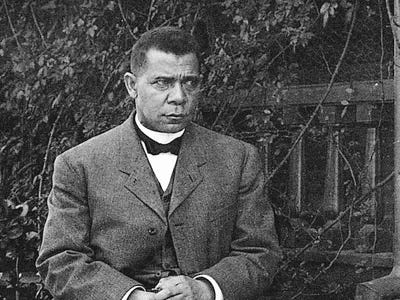
Washington heard about a school called the Hampton Institute where blacks could be educated, academically and vocationally. The school was five hundred miles away. Washington walked and begged rides much of the way but ran out of money in Richmond, Virginia, some eighty miles short of his goal. He slept under an elevated boardwalk in the city while he replenished his funds by doing odd jobs during the day until he had enough money to continue his journey to Hampton.
When Washington made it to Hampton, he worked as a janitor at the school to pay his boarding expenses as he attended classes. Working as a janitor in the late 1800s was not a picnic. One of his duties included getting up at 4:30am to build up the fires that kept the buildings warm in the winter months.
What I am trying to get across here is Booker T. Washington did not win life’s lottery. His beginnings were mired in a great deal of adversity, none of which was his choice or his fault. But he took responsibility for improving himself and circumstances, paid the price, put in the work, and consistently made the best choice available to him. Over time, his menu of good options and opportunities to do good expanded a hundred fold. By the age of twenty-five, Washington was the head of the Tuskegee Institute which he ran for thirty years, transforming it from a two building facility into a full fledged college. According to the Encyclopedia Britannica, at the time of Washington’s death, in 1915, Tuskegee had “more than 100 well-equipped buildings, some 1,500 students, a faculty of nearly 200 teaching 38 trades and professions, and an endowment of approximately $2 million.” (That is more than $50 million dollars in today’s money.)
There are a lot of people who might roll their eyes at a story like this and call it the “pull yourself up by your bootstraps trope.” They think it denigrates the value of charity and community support, as if I am saying, “quit asking for help and do it on your own, like Washington did, you slacker.” But I am not saying that at all. Throughout Booker T. Washington’s life, he received vast amounts of help, from former slaves who gave him nickels, quarters and small gifts when he left home for the Hampton Institute to millionaire philanthropists that funded his work to make Tuskegee a great institute of higher learning. The value of personal responsibility does not reject help. In fact, it is a tool that clarifies the opportunities before you, along with the help you need to seize them. Taking personal responsibility attracts helpers because doing so makes you a good investment and allows you to leverage the help you receive to the maximum advantage. Booker T Washington’s admirable initiative, work ethic and competence made him a great investment, a magnet for help from those who had help to give, whether it was a nickel or a ten thousand dollars.
To reiterate, the core honor value of taking responsibility and exercising free will does not blame the victim, ignore life’s unfairness, or denigrate the importance of help. It gives everyone their best chance to overcome the “The slings and arrows of outrageous fortune,” and make the best of things. Hopefully, the historical example of Booker T Washington de-triggers any readers who may be triggered by the phrase “personal responsibility.”
The process of taking responsibility effectively for beneficial results and the five related honor values.

Aside from the points I have just made, the example of Washington’s life illustrates another important point regarding the honor value of taking responsibility. His life was a marathon, not a sprint. The benefits of taking responsibility are gradual and accumulate over time. There may be breakthroughs here and there, but they are years in the making. Here is a quote from Jacob Riis called The Stonecutter’s Credo. “When nothing seems to help, I go and look at a stonecutter hammering away at his rock perhaps a hundred times without as much as a crack showing in it. Yet at the hundred and first blow it will split in two, and I know it was not that blow that did it, but all that had gone before.”
The benefits of taking responsibility are part of a cumulative process and may take quite a while to manifest in obvious ways. But that is okay, because taking responsibility is a way of life, the development of a personal identity, not a tactic or strategy to get a quick win. The process of making the best of yourself and your environment is never ending.
I want to drill down on how this process works, which will take us to five additional honor values that flow from taking responsibility. For this, we return to the literal meaning of the phrase “taking responsibility.”
“Taking” is a verb, an action, a choice. “Responsibility” is a compound word of two root words - Ability and Respond. Ability is what you're capable of. Your response is how you react to the continuous flow of stimulus that is your life.
Taking responsibility means you assume personal leadership to develop your Ability to Respond to life effectively. This is an essential decision, because the first person you lead is yourself. If you cannot competently direct yourself and your own actions, you have no foundation for helping others.
As you improve your Abilities, the value and effectiveness of your Responses should also improve. As you work consciously to improve the value and effectiveness of your Responses, you learn principles and skills that improve your Abilities. This is a reiterative and reciprocal process that makes you a more useful person and a benefit to those around you.
Here is an equation:
Developed Ability + Valuable and Effective Responses = Beneficial Results.
Taking responsibility is an honor value that is oriented towards beneficial results. Good intentions are woefully insufficient. I believe in the morality of long term, beneficial results attained in the real world, through justifiable means. Your results improve as you upgrade your abilities and enhance the wisdom and execution of your responses. The intention to do a good thing matters little if you lack discernment and skill to do the right “good thing” and execute it effectively. As the saying goes, “the road to hell is paved with good intentions.” Many calamities have been caused by incompetent people with seemingly good intentions.
There are five corollary honor values for taking responsibility.
These values are all aligned to improving your ability to respond and the value and effectiveness of your responses. They are courage, competence, strength, loyalty and accountability. Let’s go into them one by one.
Courage. The Oxford Dictionary says that courage is the ability to do something that frightens one .. and .. strength in the face of pain or grief. Merriam-Webster says courage is the mental or moral strength to venture, persevere, and withstand danger, fear, or difficulty.
Courage is all of these things, but we tend to Hollywoodize courage, to think of it almost exclusively in dramatic contexts. The vast majority of courage is enacted in mundane, ordinary situations. In an average life, small acts of courage outnumber and outweigh dramatic acts by like a hundred to one. Life usually does not require us to run into burning buildings or climb mountains on broken legs, but it might require us to get up every morning after a loved one has died or to look in the mirror and realize we have failed to live up to our potential or to face social alienation by standing up for sanity when the world goes nuts.
Courage requires us to to endure frustration, failure, betrayal, sorrow, boredom, discomfort and minor calamities on a daily basis. It is the accumulation of small acts of courage or cowardice that set the direction of our lives.
A small but foundational act of courage is to see ourselves, others, and the world at large more like they really are instead of what we would wish them to be. Honesty is an act of courage. In fact, it is the first step in any courageous action. Step one, honestly face the threats, faults and defects that trouble your life. Step two, overcome the inertia or doubt that would hinder you from taking action. Step three - endure and accept the consequences of taking action as you make a good faith effort to do the right things.
Courage is an act of will. But will is not enough. I might have the will to face a house fire and attempt to extinguish the flames, but if I lack the competence, I might just make things worse. If I throw water on a grease fire, I will just spread the blaze since the oil will float atop the water as the water expands its reach. If I spray water on an electrical fire, I might get myself electrocuted and cause more damage with the water than the flames would have done. My courage needs to be channeled through effective action.
Competence is also an essential honor value. We need to be able to do things and to do them well. We need good judgment to discern and prioritize the things that need to be done, along with the necessary skills and resourcefulness to do them effectively. Since we never know what circumstance may throw our way, we should strive to develop multiple competences, mental and physical. The habit of seeking and demonstrating competence is a system that we should apply every day of our life. A foundational competence that supports all our efforts is the ability to think logically and reasonably. Another foundational competence is to use your imagination to anticipate problems and make preparations that prevent them or give you an advantage when they arrive.
Now go back to our last example. Say you have the courage, the will, save your house from a kitchen fire combined with the competence to have done a little research and prepared accordingly - you purchased and deployed a fire extinguisher to smother the flames without getting you electrocuted. If a fire happens in your kitchen, you win the day. Will and skill make a great tag team.
So we have courage and competence. But they may not be enough. You can have the will and skill to do something, but still lack the physical or mental Strength to get the thing done. For example, you may have the courage to dive into flood waters to attempt a rescue and be a competent swimmer, but without the physical toughness, energy and endurance to carry it out, you will fail. Strength also includes mental discipline and capacity. You might have the courage to attempt medical school, along with many academic skills, but without the mental fortitude it takes to learn and apply the course of study, it does not matter much. Self discipline, physical and mental, is a foundational strength. Courage gives you the will, competence gives you the skill and strength gives you the capacity. These abilities will take you far in life.
Most people do not come to a bad end because they don’t know what needs to be done. They come to a bad end because they lack the courage, competence or strength to do what’s needed.
These three honor values are about developing your Ability to respond effectively to life. But here is a caveat. You can do something very foolish or bad with great efficiency, but that makes your action no less destructive. Quality responses are more than just well executed, they have value and effectively meet a need. The most perfectly constructed shovel in the world, with a diamond tipped digging blade is not as valuable or effective as a plain coil of rope when you need to be pulled out of a deep hole. The next two honor values are important to shaping the value and effectiveness of your responses.
To recap, courage, competence and strength give us the will, skill and capacity to execute our responses. Loyalty is the honor value that provides the why and the “for whom.”
Nietzsche said “He who has a why to live for can bear almost any how.”
The core principle of honor - self leadership and personal responsibility directed towards making something meaningful of your life - requires a great deal of loyalty to yourself and self development. But it also requires you to focus on things beyond yourself, because mere self interest is not enough to get you through the really hard times. Honor requires some sort of larger purpose, a higher power, transcendent principles and loyalty to others. Religion often provides all of these things - the higher power, transcendent principles and an imperative to love others.
But you do not need to join a religion to live according to religious values. Just know that you cannot reach your full potential without some form of external loyalty. As Stephen Covey once explained, independence will take you far, but interdependence - trust, cooperation and teamwork with others, will take you much further. Loyalty is the binding agent for interdependence.
Loyalty is a combination of gratitude and duty - gratitude for those you can trust and depend on, that have helped sustain you - and the duty to reciprocate by being trustworthy, dependable and sustaining them in return.
Loyalty is not something that is given blindly or in equal measures to all. To explain this, let me use a river metaphor. Rivers may be broad. Rivers may be deep. They may be both. But for loyalty, broad and deep usually do not go together. For example, you have a baseline loyalty to your fellow human beings. Obviously, that is a very broad category, so the depth of loyalty is somewhat limited. Our loyalty to humanity is just to be decent, follow the Golden Rule and do minimal harm.
The Golden Rule, “do not do unto others as you would not have them do unto you,” is a powerful and important principle. We are all vulnerable sometimes. In our lifetime, we will be around thousands of people who are in a position to hurt or exploit us or simply withhold help they could easily give. Most of them will not do so, but act fairly and decently. So we owe others the same respect.
So now let’s narrow things a bit from humanity in general to our country and fellow citizens. We live in a country that has provided us with the legal, social and physical infrastructure to live better than 90% of the rest of the world. So the loyalty owed here deepens a bit. We have a responsibility to be a good citizen. We should be law-abiding, competent and contribute in some way - pull our own weight, do useful work, pay our taxes, maybe even engage in military service.
But let’s narrow things even more, to groups we are affiliated with, such as our school, place of worship, workplace, social club, neighborhood and so on. To these we owe a deeper level of loyalty that might require a degree of commitment, sacrifice and compliance. I may need to study late into the night, come to work on a Saturday, or join the neighborhood watch out of loyalty to these affiliations.
When it gets narrowed down to family, especially our children, loyalty becomes serious. Loyalty here might require a big sacrifice, like working years of double shifts to start a college fund or staying in a rocky marriage for the sake of the kids.
So, you can see the progression. I should be nice and helpful to my neighbor’s kids, but I am honor bound to make sacrifices for my own. I am not working an extra job to put your kids through college.
My duty to be loyal is also defined by different roles or professions that I have voluntarily assumed. If I take a job as a mechanic, I owe a debt of loyalty to my employer, my colleagues and the customers’ whose cars I service. If I take on a role but fail in the fundamental responsibilities intrinsic to that occupation, my behavior is dishonorable. A teacher who willfully fails to improve students’ reading, writing, and math skills, is a terrible teacher engaged in dishonorable conduct. A parent who brings a child into the world but neglects to nurture and civilize him in preparation for a successful life, is a terrible parent and a dishonorable person.
If you have conflicting loyalties, you must do some soul searching to set priorities and sort out where your greatest loyalty lies. This does not make you mean or selfish. It is a question of responsibility. You do not hate your neighbors’ kids because you prioritize your own children, do you? To be part of a valuable and effective response, our courage, competence and strength need to be directed in the right ways, for the right reasons and on behalf of the right people.
Accountability. Life is a process of trial and error in the face of adversity and resistance. Improvement can be complicated and hard. You often have to get better just to keep from losing ground. Accountability is a great tool to develop abilities and improve the value and effectiveness of your responses.
There are three kinds of accountability that pertain to process-based activities with repeating cycles.
A1 - Begin with the accountability of guiding principles and lessons learned.
A2 - Do your job based on the accountability of clear goals, standards and criteria.
A3 - Take accountability for your results, evaluate outcomes, identify new lessons learned, validate or refine guiding principles.
Come back around.
B1 - Back to guiding principles and lessons learned.
B2 - Do your job based on clear goals, standards and criteria
B3 - Own your results, evaluate outcomes, identify new lessons learned, validate or refine guiding principles.
Come back around.
C1 - Back to guiding principles and lessons learned.
C2 - Do your job
C3 - Own your results
Over and over again.
There is an old saying, feedback is the breakfast of champions. These three kinds of accountability - guiding principles; standards and criteria; and owning your results - in a constant feedback loop, are the breakfast, lunch and dinner of champions. Over time, they improve every variable in the taking responsibility equation.
The accountability feedback loop helps you sharpen your abilities and improve the effectiveness of your efforts, leading to better results over time.
Summary and Application.
The core honor value is to take responsibility for improving yourself and your environment. As you move through life, you receive an unending flow of stimulus from your biology, circumstances, environment and perceptions. Your goal is to develop the ability to respond effectively to this stimulus and create beneficial results for yourself and others. Courage, competence and strength are honor values that improve your abilities. Loyalty is an honor value that clarifies the purpose behind your responses - the why and for whom. Loyalty helps you choose the right response for the right reason. The accountability of guiding principles that clarify loyalty, morality and wisdom lead you to choose beneficial responses. The accountability of goals, standards, owning your results and seeking improvement also refine your abilities to execute your responses more effectively.
I began this discussion of honor values by making two assertions. One, honor applies to every context and to every person, including humble folks in common, mundane settings. Two, honor values were a dominant part of the culture at Waialua Elementary School, and a major driver of our success, including the accomplishment of winning two National Blue Ribbons in nine years. I hope that my explanation of the honor values and my description of our success at Waialua Elementary demonstrate that those claims are clearly true.
It seems self-evident that you do not find organizational success without those in the organization taking responsibility for its success. The only way you could refute this claim is to find an organization that had sustained success while its members rejected personal responsibility. That seems unlikely.
What about the other honor values? Here is a brief synopsis of what they looked like at Waialua Elementary.
Courage and Accountability. It takes courage to look in the mirror every day and be honest about what you see and don’t see. Our mirror at Waialua Elementary was data and direct observation. We took data for every school priority. At any given time, we could produce growth and achievement data for every student at our school - reading, writing, math and behavior. We also gathered survey data from students, staff and the community each year. Everyone got to rate themselves and everyone else, including me. We were transparent. Everyone’s data (minus names) was out there for review and comparison. We also compared our school’s data against that of other schools. You might think you are doing the best you can, but you realize you can and should do better when the teacher down the hall, the grade level above you or the school down the street is consistently getting better results than you with the same challenges that you have. At that point, you need the courage to suck it up and figure out what effective thing they are doing that you are not … or what counter productive thing you are doing that they are not.
The courage and accountability also applied to students and their parents. At the beginning of each year, we shared the grade level’s promotion matrix, which laid out exactly what students needed to accomplish to be promoted to the next grade. We used internet based programs that allowed parents to monitor their children’s work and progress. Students and parents got direct feedback and could see what strategies worked and failed on their end. They almost always responded accordingly, because our school did not do social promotion. When students advanced to the next grade, it was because they earned it.
Competence and strength. We did not just concern ourselves with academic achievement data. We also took behavioral data. The foundation of learning is behavior. Learning is a behavior as are its components. Did you pay attention? Did you ask questions? Did you follow instructions? Did you apply the effective strategies your teacher taught you, or did you just wing it?
For any endeavor, there are a narrow band of tactics and strategies that work and many that lead to failure. Learning is a process where you figure out what works and what does not work. Little things matter, like properly labeling your work as you do a math story problem so you keep your variables straight or asking your teacher to move you away from your friend because the two of you distract each other.
As a school, we taught students general strategies, like Stephen Covey’s The 7 Habits of Highly Effective People, and specific tactics, like writing notes in the margin of texts and underlining all the words they did not know. We wanted students to grow and achieve, but we always wanted them to understand the attitudes, behaviors and habits that led to growth and achievement. We were very big on habits. In fact, it is part of Wailua’s Mission Statement: Our mission at Waialua Elementary School is to empower & challenge students to gain the skills, knowledge & habits that will enable them to become responsible and effective leaders.
Good Habits are to the mind as power tools are to a carpenter. They help you consistently execute your intentions and overcome your own inertia. This is a form of strength. We sought to empower our students by building up their competence and fortitude.
Loyalty. First loyalty at Waialua Elementary was to our students - to give them what they needed to become successful learners and human beings. This included things like an extra adult in every classroom to help with student support and afternoon academies that gave children the opportunity to participate in extracurricular activities in addition to their core subjects in the morning. We emphasized both academics and social emotional learning. Our goal was to give students what they needed. Sometimes they needed a hug and sometimes they needed to be nudged in the right direction with accountability and consequences. We were big on “prepare the child for the path and not the path for the child.”
Our next loyalty was to our staff. We went out of our way to take care of them, have their back and keep their path clear of obstacles and distractions. We gave teachers as much autonomy as possible, provided their choices coincided with student wellbeing and achievement - and they almost always did. I am sure that almost every administrator claims to prioritize supporting teachers, so let me offer an example to support my claim. Every school in my state is required to have a union based Association Policy Committee (APC), a problem-solving body on campus that should meet with the principal monthly to address teacher or union issues. Our loyalty values were such that we already addressed teacher needs in real time through an open door policy, open communication and proactive support. A few months into my tenure as principal, the teachers on the committee felt the monthly meetings were a waste of their time and asked if we could dispense with them. My answer was “I won’t tell the union if you don’t,” so we went almost fifteen years without another APC meeting, until the year Covid struck and the union insisted the meetings start back up, only for them to peter out again for the same reason.
After students and teachers, our loyalty was next directed to parents, expressed in maintaining open communication, seeking cooperation, and being clear and transparent in how and what we were teaching their children. Our basic policy was to respect parental rights and defer to their wishes as long as they were not unreasonable or counter productive.
Coming in fourth place in our loyalty ranking was the Department of Education bureaucracy that provided us with our funding and many helpful policies and guidelines. Of course, we obeyed all laws and ethical requirements, but if a policy sometimes conflicted with our loyalty to students or staff, we might respond with a “don’t ask; don’t tell” or “ask for forgiveness, not permission” approach.
Loyalty is such a critical honor value and it was the pre-existing foundation that was already in place when I first walked on campus at Waialua Elementary School in 2004. This value, combined with taking responsibility, allowed us to evolve from a wonderful, nurturing school into a wonderful, nurturing school with high achieving students with enhanced life skills to carry into the future. We won two National Blue Ribbons by asking ourselves “what do the students need to be successful when they leave us and go off into the world and how do we give it to them?” The answer to those questions led us to the honor values.
Personal Responsibility
Courage
Competence
Strength
Accountability
Loyalty
Thank you for your time and kind attention.